
Recent Position at the Naval Research Laboratory
From August 2023 to December 2025, I was a National Research Council (NRC) Research Associate at the U.S. Naval Research Laboratory (NRL) in Washington, D.C.; I am currently finishing up the peer-review process to publish the first discovery of 340 MHz emission from an ultracool dwarf (arXiv:2512.11120) using NRL’s VLITE database. VLITE is an ongoing experiment with over a decade of observations across the observable sky, taken simultaneously with Very Large Array GHz observations. The discovery motivates observations at the scarcely pursued 340 MHz frequency to reveal otherwise illusive signals from coronal mass ejections or star-planet interactions. Such a study holds the possibility of measuring an exoplanet magnetic field for the first time.
Other highlights of my time at NRL include leading and supporting the optical component of a radio survey of pulsars, unraveling the mysteries behind unusual radio emission from a K dwarf, and reviewing just how complicated it is to measure the occurrence rate of Earth-like exoplanets in the habitable zones of Sun-like stars (in collaboration with members of SIG 2). See my publications for more details.
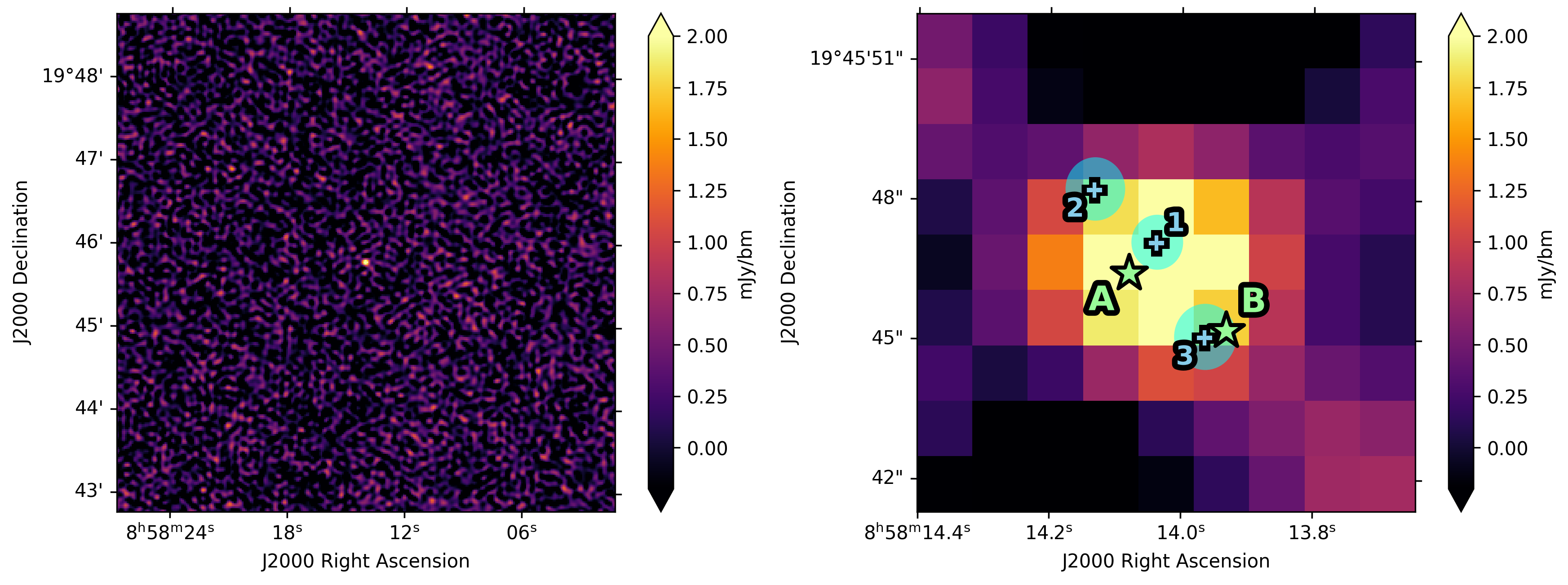
“First Detection of an Ultracool Dwarf at 340 MHz: VLITE Observations of EI Cancri AB”
Silverstein et al. 2025 | NASA ADS (arXiv)
Key Collaborators
- U.S. Naval Research Laboratory
- NASA Goddard Space Flight Center
- Research Consortium on Nearby Stars (RECONS)
Working Group Memberships
Collaboration with the TESS Team
In August 2019, I joined the TESS team at NASA Goddard Space Flight Center in Greenbelt, MD. I was a NASA Postdoctoral Program Fellow for three years and held a Postdoctoral Research Associate faculty position at the University of Maryland, Baltimore County (UMBC) for one. My research focused on nearby low-mass stars, with an emphasis on understanding the fully convective boundary, flare star properties, and transiting planets.
I led the discovery and characterization of the LHS 1678 exoplanet system (Silverstein et al. 2021, 2024), a nearby “Gaia gap” M dwarf with an uncommon history, hosting a scarcely detected substellar companion in a decades-long orbit and three rocky planets that are candidates for atmospheric characterization with JWST. The three planets are some of the smallest to date and include an ultrashort period planet and two Venus-zone planets in near-resonance. This deep-dive effort to comprehensively understand each component and the system as a whole included data from 15 different telescope systems with time baselines as long as 16 years and ranging from direct imaging to ground-based astrometry to high-precision radial velocity data and more. I intend to continue work on this system, while bringing my experience in holistic exoplanet system characterization to collaborations on other systems and projects.

“Validation of a Third Planet in the LHS 1678 System”
Silverstein et al. 2024 | NASA ADS
Continued Connection with RECONS
Collaboration with the RECONS team is ongoing, most notably on topics of astrometry and ground-based observations.
Promoting Small Telescopes: Although my time as the official “SMARTS Graduate Fellow” is over, I continue to promote the use of small telescopes in Chile, namely the SMARTS/CTIO 0.9m and SMARTS/CTIO 1.5m telescopes at CTIO. I am happy to discuss (1) whether either of these telescopes are right for your goals, (2) how to apply for or buy time, (3) how to obtain observations, (4) what to do with the resulting data, or (5) any other questions you may have.
The Tie between RECONS and SMARTS: RECONS currently runs two telescopes on the mountain in Chile. The first is the SMARTS/CTIO 0.9m telescope, at which we have an ongoing 25-year astrometry program. The long time-baseline of the program, extraordinary stability of the telescope and camera, and expertise of the team make this program a strong contributor to astrometric and photometric studies of nearby stars, even in the era of Gaia astrometry (publications). RECONS also runs the SMARTS/CTIO 1.5m telescope, most notably leading a comprehensive K dwarf radial velocity survey and providing key follow-up of exoplanet candidates.
Acronyms:
- CTIO – Cerro Tololo Inter-American Observatory
- NASA – National Aeronautics and Space Administration
- NRC -National Research Council
- NRL – Naval Research Laboratory
- RECONS – Research Consortium on Nearby Stars
- SIG 2: Science Interest Group 2
- SMARTS – Small and Moderate Aperture Research Telescope System
- TESS – Transiting Exoplanet Survey Satellite (NASA Page, MIT Page)
- VLITE – VLA Low-band Ionosphere and Transient Experiment
 Michele L. Silverstein, Ph.D.